Recent Posts


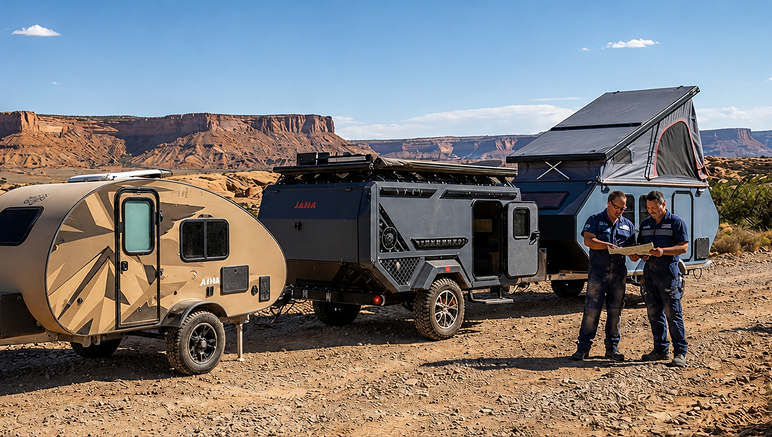
Buying a caravan factory-direct from China is appealing for obvious reasons — you get a higher spec for the money and far more say over the build. The part that catches people out isn’t the van. It’s everything between the factory floor and your driveway: approvals, compliance, quarantine, customs and state registration.
Here’s the real process in plain English, so you know what you’re taking on — and where the genuine risks sit.
First, the big change: the RVSA
Since 1 July 2023, every road vehicle supplied to the Australian market for the first time falls under the Road Vehicle Standards Act 2018 (RVSA), which replaced the old Motor Vehicle Standards Act. A caravan is treated as a trailer under these rules, and the days of quietly self-certifying an imported trailer are over.
The headline for buyers: an imported caravan generally can’t be registered until it has been approved and listed on the Register of Approved Vehicles (RAV) — think of the RAV as a digital compliance plate the government (and your state) can look up.
Step by step
1. Confirm it can meet the Australian Design Rules (ADRs). The ADRs are national safety standards. For a caravan, the relevant ones cover things like the drawbar, couplings, brakes, reflectors, lighting and tyres. A van built only for the Chinese domestic market won’t automatically meet them — the build has to be specified correctly before it’s made.
2. Get an import approval through ROVER. ROVER is the federal Road Vehicle Regulator’s online portal. There are two pathways that matter for caravans (which are “low ATM trailers” — 4.5 tonnes ATM or less):
- Vehicle Type Approval (VTA): required for a business importing more than four identical trailers in a 12-month period. It demands evidence of design control and a quality system.
- Concessional RAV Entry (CRE): the common pathway for an individual or anyone bringing in four or fewer units. Simpler, no quality-management system required, and it issues a VIN.
3. Sort the VIN. Australian manufacturers can generate their own VINs. Importers can’t — the VIN must be supplied from the country of origin and then marked on the compliance plate (it’s wise to stamp it into the drawbar too).
4. Get it onto the RAV. Once approval is granted, the van’s details are entered on the RAV. Until that’s done, your state authority generally won’t register it.
5. Shipping and customs. The van travels by ocean freight, then clears the Australian Border Force. Expect import duty (commonly around 5%) plus 10% GST, both calculated on the value — budget for these from day one, because they’re the costs people forget.
6. Biosecurity (this one bites). The Department of Agriculture, Fisheries and Forestry inspects imported goods for contamination. The van must be steam-cleaned inside and out with no soil, plant matter or pests, and Australia has a zero-tolerance approach to asbestos — testing (and removal, if anything is found) can be required. Always check the BICON database for the specific conditions.
7. Gas and electrical compliance. A caravan sold here needs Australian plugs and fittings and, where gas is fitted, a gas compliance certificate. This has to be designed in, not bodged on arrival.
8. State or territory registration. This is the step most people misunderstand: federal import approval does not equal registration. Each state and territory (VicRoads, Transport for NSW, and so on) runs its own process, and you’ll deal with them directly to get plates.
Where it goes wrong
The unmanaged imports that end badly usually share the same failures: a van specced for the wrong market that won’t pass ADRs, no pre-shipment inspection (so faults are discovered after it lands), surprise asbestos or quarantine holds, duties and GST the buyer didn’t budget for, and no support when something needs fixing 12 months later.
None of these are reasons not to import. They’re reasons to import properly.
How we remove the risk
This entire process is the business we’re in. China Caravans manages sourcing, the independent pre-shipment inspection, the approvals and VIN, RAV entry, ocean freight, customs clearance and duties, compliance, and delivery to your driveway — then backs the van with a 12-month national warranty and Australian-based support. You get the factory-direct advantage without personally becoming an expert in the RVSA.
A note on the rules: import and registration requirements change and vary by state. This article is general information, not legal advice — always confirm current requirements with the federal Road Vehicle Regulator (ROVER), the Australian Border Force, DAFF biosecurity (BICON) and your state registration authority.