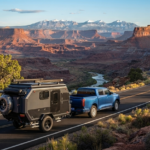
Before you compare brands or floorplans, get the type right. It’s the single decision that shapes everything else — what you can tow, where you can go, how long you can stay out, and what you’ll pay. Pick the wrong category and even a great van will feel like a compromise.
Here’s a plain guide to the main types we import, and how to land on the one that fits you.
The five types, quickly
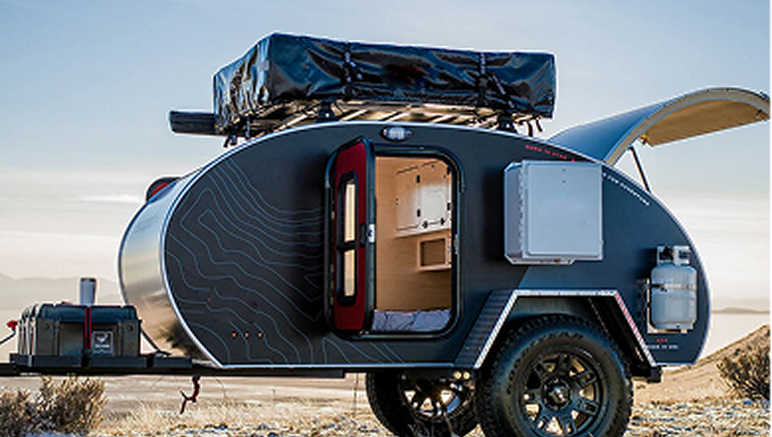
Teardrop camper — the smallest and lightest option. A cosy sleeping cabin for two, usually with an outdoor kitchen in the rear hatch. It tows behind almost anything, sets up in minutes and stores in a normal garage. Best for couples doing weekends and short trips who are happy to camp outside the van. Trade-off: no standing room inside, and bathrooms are limited (some include a compact shower).
Mini / compact caravan — a small hard-walled van with an internal bed, a kitchenette and often a little bathroom. You get caravan comforts — sleep inside, out of the weather — in a package light enough for a mid-size SUV or 4WD. Ideal for couples who want comfort without a big rig.
Off-road camper trailer — built to go where caravans can’t. Rugged chassis, serious clearance, and a fold-out or rooftop tent setup. Lighter and more agile than a full van, so it’s the choice for remote tracks and proper 4WD touring. Trade-off: more setup at camp, and you’re sleeping in a soft-sided area.
Hybrid — the in-betweener, and increasingly the sweet spot. It blends a camper trailer’s toughness and compact size with a caravan’s hard walls, internal bed and (often) an ensuite. Great for couples who want to free-camp off-grid in remote country but still sleep inside and set up fast.
Full off-road caravan — the most self-contained option: room to move, full kitchen and bathroom, big water and power, space for a family. Perfect for long trips and the Big Lap — provided you have a genuinely capable tow vehicle to match (more on that below).
How to choose: five honest questions
- Who’s travelling? Just the two of you opens up teardrops, mini vans and hybrids. Travelling with kids points you toward a family-sized off-road caravan with bunks.
- Where will you actually go? Mostly bitumen and powered sites? A mini or full caravan is comfortable and easy. Chasing remote, corrugated tracks? Lean off-road camper trailer or hybrid.
- How long are your trips? Weekends and the odd week suit smaller, quicker-to-set-up rigs. Months on the road reward the space, water and power of a hybrid or full van.
- What can your vehicle tow — really? This is where most plans come unstuck. A hatchback or small SUV handles a teardrop; a mid-size 4WD suits a mini van or camper trailer; a full off-road family van needs a large 4WD with the payload to match, not just a big towing number. (Our caravan towing weights guide walks through exactly how to check.)
- What’s your setup tolerance? Some people happily pitch an awning and rooftop tent; others want to pull up, level, and be inside with the kettle on in five minutes. Be honest — it changes the answer.
A quick matcher
- Couple, weekends, any car, minimal fuss → Teardrop camper
- Couple, comfort, mid-size SUV/4WD, mostly sealed roads → Mini / compact caravan
- Couple or small group, remote 4WD tracks, lightweight → Off-road camper trailer
- Couple, off-grid touring, want to sleep inside and set up fast → Hybrid
- Family, long trips, fully self-contained, capable tow vehicle → Full off-road caravan
Still not sure?
That’s normal — most people sit between two types, and the right call comes down to your specific vehicle and travel plans. Tell us how you camp, where you want to go and what you’ll tow with, and we’ll shortlist the layouts that actually fit. No upsell to a bigger van than you need.